Pillar Guide
What size AC do I need for my home in Ontario?
Most Oxford County homes need between 1 and 3 tons of cooling capacity — 12,000 BTU for a small bungalow up to 36,000 BTU for larger 2-storey homes. The right number comes from Manual J, not square-footage shortcuts. Here's the math.
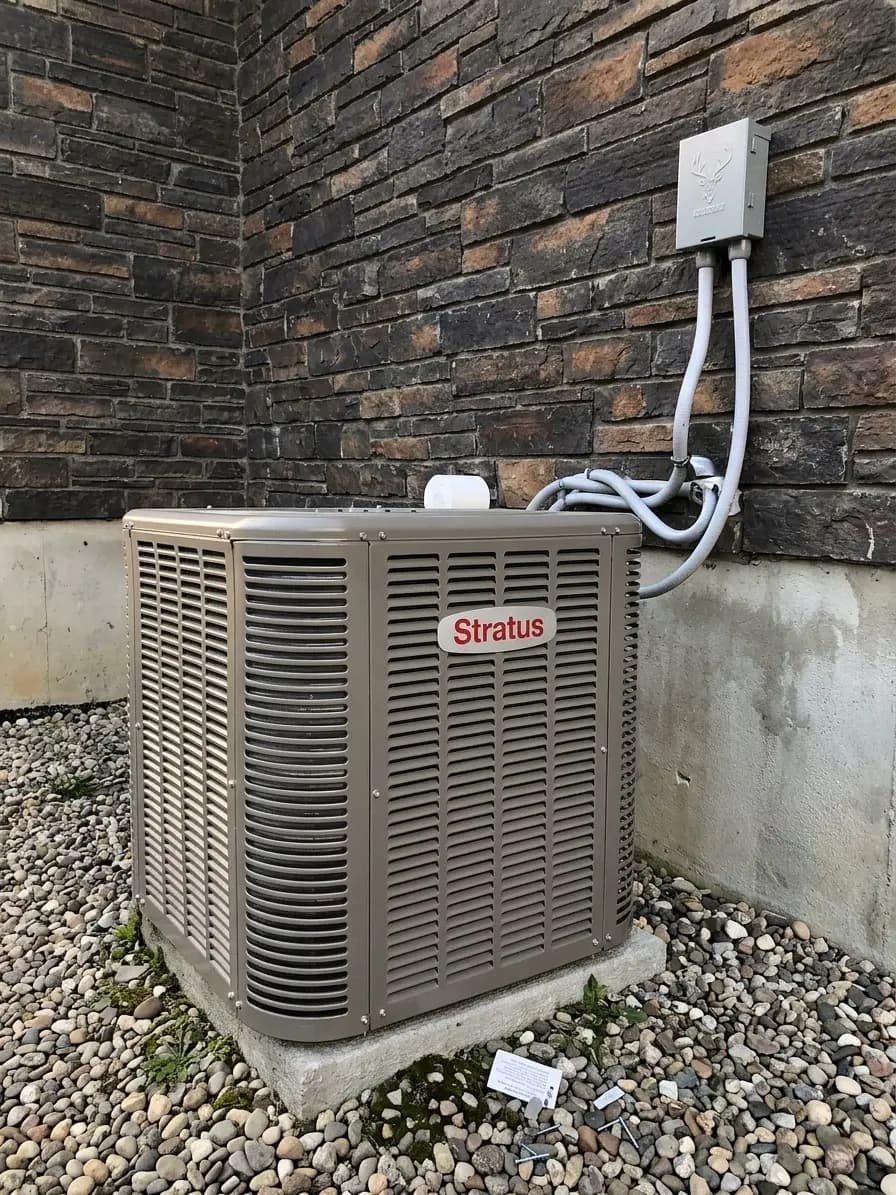
Most Oxford County homes need between 1 and 3 tons of cooling capacity — 12,000 BTU for a small bungalow up to 36,000 BTU for a larger 2-storey home. The right number for your specific home comes from a Manual J heat-load calculation, not a square-footage shortcut. Oversizing by even half a ton causes short-cycling, uneven temperatures, and poor humidity control — common problems we're called to fix on systems that were sized by guessing.
This guide explains how AC sizing actually works, the typical BTU ranges for Oxford County homes by size and vintage, and how to tell whether your existing AC is correctly sized before you replace it.
The short version
| Home size | Typical AC tonnage | Typical BTU |
|---|---|---|
| Small bungalow 800-1,200 sq ft | 1 ton | 12,000 BTU |
| Small 2-storey or larger bungalow 1,200-1,800 sq ft | 1.5 ton | 18,000 BTU |
| Average 2-storey 1,800-2,400 sq ft | 2 ton | 24,000 BTU |
| Larger 2-storey 2,400-3,200 sq ft | 2.5 ton | 30,000 BTU |
| Large 2-storey or older drafty home 3,200-4,000 sq ft | 3 ton | 36,000 BTU |
| 4,000+ sq ft or poor envelope | 3.5-4 ton | 42,000-48,000 BTU |
These are starting-point ranges, not specifications for your home. Two homes the same size can need different AC tonnage based on insulation, window quality, ceiling height, sun exposure, and ductwork. A proper Manual J calculation accounts for all of these — and is the only honest way to size an AC.
What "ton" actually means
One ton of cooling = 12,000 BTU/hr of heat removal. The number comes from the cooling effect of one ton of ice melting over 24 hours — a unit of measure from the pre-refrigerant era that stuck around.
In practical terms:
- 1 ton = 12,000 BTU = ~400 CFM of cool air at a 20°F temperature drop
- 1.5 ton = 18,000 BTU = ~600 CFM
- 2 ton = 24,000 BTU = ~800 CFM
- 2.5 ton = 30,000 BTU = ~1,000 CFM
- 3 ton = 36,000 BTU = ~1,200 CFM
- 4 ton = 48,000 BTU = ~1,600 CFM
ACs are sold in half-ton increments. There's no such thing as a 1.7 ton AC — you go up or down a half size.
Why proper sizing matters
The instinct is "bigger is better — more cooling capacity means more comfort." It's wrong. An oversized AC causes more problems than an undersized one:
Short-cycling
An oversized AC cools the air temperature fast — sometimes in 5-10 minutes — and shuts off. Then the house warms back up and the cycle repeats. Each cycle stresses the compressor, wears electrical components, and burns electricity at start-up rates. Lifespan drops, repair frequency rises.
Poor humidity control
ACs remove humidity in the second half of a cooling cycle, once the coil has cooled below dew point. An AC that runs for 5 minutes barely starts dehumidifying. An AC that runs for 20-25 minutes hits its dehumidification stride. Oversized ACs leave the house feeling cold and clammy — the temperature is right but the humidity is wrong.
Uneven temperatures
Short cycles mean the system never pushes long enough to fully condition all the rooms in the house. Rooms farthest from the air handler stay warm; rooms closest get overcooled. The result is constant thermostat fiddling.
Premium price for worse performance
A 3-ton AC costs $1,000-$1,800 more than a 2-ton AC. Paying that premium to get a system that performs worse is a clean lose.
Electrical and refrigerant stress
Oversized systems pull more amperage on startup and need more refrigerant. Both add cost over the life of the unit.
The classic short-cycling complaint — "my AC runs for 5 minutes then shuts off, then comes back on, and the house is uncomfortable" — is almost always an oversized unit.
Manual J — the right way to size an AC
Manual J is the residential heat-load calculation method published by the Air Conditioning Contractors of America (ACCA). It's the industry standard for HVAC sizing, used by every legitimate contractor.
A proper Manual J accounts for:
- Square footage by room (not just whole-house)
- Ceiling height (cathedral ceilings change the load significantly)
- Insulation in walls, attic, basement (R-values)
- Window count, size, orientation, and quality (single-pane vs double-pane vs triple-pane; south-facing vs north-facing)
- Air infiltration rate (how leaky the house is — old vs new build)
- Internal heat gains (appliances, people, lighting)
- Solar gain (sun exposure on each elevation)
- Local climate design temperatures (peak summer temperature for sizing — for Oxford County, this is roughly 30°C / 86°F)
- Latent load (humidity removal requirements)
The output is a specific BTU number for cooling load (and a separate one for heating, used to size the furnace or heat pump).
A proper Manual J takes 30-90 minutes for an experienced tech using software (Wrightsoft, Elite Software, RHVAC). It produces a detailed report you can keep.
A "rule of thumb" sizing — 500 sq ft per ton, or 600 sq ft per ton — takes 2 minutes and usually oversizes by half a ton or more.
What the square-footage rules get wrong
The most common rule of thumb you'll hear: "1 ton per 500-600 square feet." It's wrong for almost every Oxford County home, in either direction.
Newer well-insulated homes (post-2010)
The rule oversizes these by 25-40%. A modern 2,400 sq ft 2-storey with R-60 attic insulation, R-22 walls, triple-pane windows, and proper air sealing might need 1.5-2 tons — not the 4 tons the rule suggests.
Older drafty homes (pre-1980)
The rule undersizes these in some cases, oversizes in others. A 1970s 1,800 sq ft home with original windows, R-12 walls, and significant air leakage might need 2.5 tons in spite of the rule's 3-3.5 ton prediction — the air infiltration drives down sensible load.
Cathedral ceilings, lots of glass, southern exposure
The rule has no way to account for these. A loft-style home with 12-foot ceilings, picture windows on the south side, and a lot of sun gain in summer can need 30-50% more capacity than the floor area suggests.
The rule of thumb was invented when houses were leaky, windows were single-pane, and air conditioning was a luxury. Modern building envelopes broke the rule. Smart contractors don't use it.
Typical Oxford County numbers — by vintage and size
These ranges assume reasonable insulation and standard ductwork. Your specific home's number depends on Manual J output:
| Home vintage | 1,200 sq ft | 1,800 sq ft | 2,400 sq ft | 3,000 sq ft |
|---|---|---|---|---|
| Pre-1970 (original windows, R-12 walls, drafty) | 1.5 ton | 2-2.5 ton | 2.5-3 ton | 3-4 ton |
| 1970-1990 (some upgrades, original or replacement windows) | 1.5 ton | 2 ton | 2.5 ton | 3 ton |
| 1990-2010 (better insulation, vinyl windows) | 1 ton | 1.5 ton | 2 ton | 2.5 ton |
| Post-2010 (good envelope, double or triple-pane) | 1 ton | 1.5 ton | 1.5-2 ton | 2-2.5 ton |
| Net-zero or passive house | 0.5-1 ton | 1 ton | 1-1.5 ton | 1.5 ton |
These are typical, not guaranteed. A 1990s home with major addition work that wasn't properly insulated might need to be sized like a 1970s home. A 1970s home that's been deep-retrofitted with spray foam might need the post-2010 sizing.
How to tell if your existing AC is sized right
Before you replace, look at how the current AC is behaving. A correctly-sized AC:
- Runs in 20-30 minute cycles on a typical summer day (not 5-10 minute short cycles, not constant runs without ever cycling off)
- Keeps the whole house within 1-2°C of setpoint (no 4°C swings between bedrooms and main floor)
- Removes humidity effectively (indoor humidity stays in the 45-55% range on humid days)
- Reaches setpoint within 1-2 hours of a 5°C temperature drop request (not 4 hours, not 15 minutes)
- Doesn't trip its breaker or struggle to start on hot days
If your existing AC has been short-cycling, leaving rooms clammy, or fighting itself for years, the replacement is your chance to right-size. Sometimes the data plate on the existing outdoor unit is also a clue — a 3-ton unit on a 1,500 sq ft post-2000 home is almost certainly oversized.
What to ask a contractor about sizing
When you're getting quotes for AC replacement or new installation, the sizing question separates the careful contractors from the eyeball-it crowd. Reasonable questions:
- "How do you determine the AC size?" — Manual J is the right answer. Square-footage rule is the wrong answer. "Same size as your existing unit" is also wrong if the existing unit is oversized.
- "Will you show me the load calculation?" — A real contractor will share the Manual J report. If they won't, they probably didn't run one.
- "What about my windows / insulation / sun exposure?" — If they don't ask about these, they aren't running a real load calc.
- "Is there a chance my existing unit is oversized?" — If they say "the existing unit was right and we'll match it," push back. Most older replacements were sized by the same rule-of-thumb logic that's wrong now.
- "What about ductwork capacity?" — Ducts have airflow limits. A 3-ton AC on ductwork sized for 2 ton will starve for air and underperform. Real sizing checks both.
A contractor who pushes back with "we've been doing it this way for 20 years" is doing it the wrong way. Modern Manual J takes under an hour with software; there's no excuse not to run it.
Why oversized AC was so common before
Walk through any Oxford County subdivision built between 1970 and 2010 and you'll find a lot of homes with oversized AC. A few reasons:
- Old rules of thumb got passed down through contractor training
- Insulation upgrades happened on existing homes (windows replaced, attic re-insulated) but AC was never resized to match
- Adding 50% was a "safety margin" sales tactic — bigger AC, bigger invoice
- Customers asked for it — "I want the powerful one"
- Equipment was less efficient — older equipment didn't dehumidify as well, so contractors compensated by upsizing
- Manual J wasn't accessible — software wasn't cheap, training wasn't universal
Today, none of those reasons hold. Equipment dehumidifies better than ever, insulation upgrades shrink the load, and Manual J software is standard in any legitimate HVAC shop.
When a smaller AC actually fits better
We've replaced more than a few 3-ton ACs with 2-ton units (and a few 4-ton with 2.5-ton) on Oxford County homes where the existing system was oversized. The customer's experience:
- House cools faster, not slower (because the new system runs longer cycles and pulls humidity out)
- Indoor humidity drops noticeably — the "clammy" feeling goes away
- Electricity bill drops 10-20% in summer
- Bedroom-to-bedroom temperature variance shrinks
- The unit is quieter (smaller compressor + larger duct system = lower velocity)
The objection we hear: "but won't a smaller unit struggle on a really hot day?" If sized right via Manual J, no — Manual J sizes for the local design temperature (the temperature your home would see for the hottest 1% of summer hours). On those few peak days, the AC runs continuously without short-cycling, which is exactly what it's designed to do.
Heat pump sizing — the same math
If you're considering a heat pump instead of a straight AC (current rebates make this attractive — see our heat pump cost guide), the sizing math is the same in cooling mode. The added wrinkle: heat pump sizing also needs to account for heating load.
Heat pumps in Ontario are sized as either:
- Cooling-load sized — the heat pump handles AC, and a backup furnace handles heating (hybrid setup, most common for retrofits)
- Heating-load sized — the heat pump is sized to handle the home's heating load alone (only feasible in newer well-insulated homes)
See our heat pump vs furnace for Oxford County winters guide for the full hybrid-vs-pure-heat-pump conversation.
Common questions
Can I just match the size of my existing AC?
Only if you're sure the existing one was right. Most replacements we see are oversized — matching the old unit perpetuates the problem.
How accurate is Manual J?
Within 5-10% of actual load, which is plenty accurate for sizing. The variability between two correctly-run Manual Js on the same house is small. The variability between Manual J and a square-footage rule is huge.
What if my contractor doesn't do Manual J?
Get a different contractor. Sizing without Manual J in 2026 isn't professional practice — it's eyeballing.
Does ductwork affect AC sizing?
Yes. Ducts have airflow limits — if your ductwork can only deliver 800 CFM, a 3-ton AC (needs ~1,200 CFM) will be airflow-starved and underperform. A real Manual J includes duct sizing analysis.
Can I oversize on purpose for "growing into" a future addition?
No — install the right size for the current house, then upsize when the addition is built. Running an oversized AC for years until you get around to the addition wastes money and runs a worse system.
What about variable-speed ACs?
Variable-speed compressors can ramp their output between roughly 35-100% capacity — meaning they're more forgiving of slight oversizing because they can match output to load. But oversizing a variable-speed unit by a full ton still wastes money on equipment that's never running at higher capacity. Manual J still applies.
How do I know what my existing AC's tonnage is?
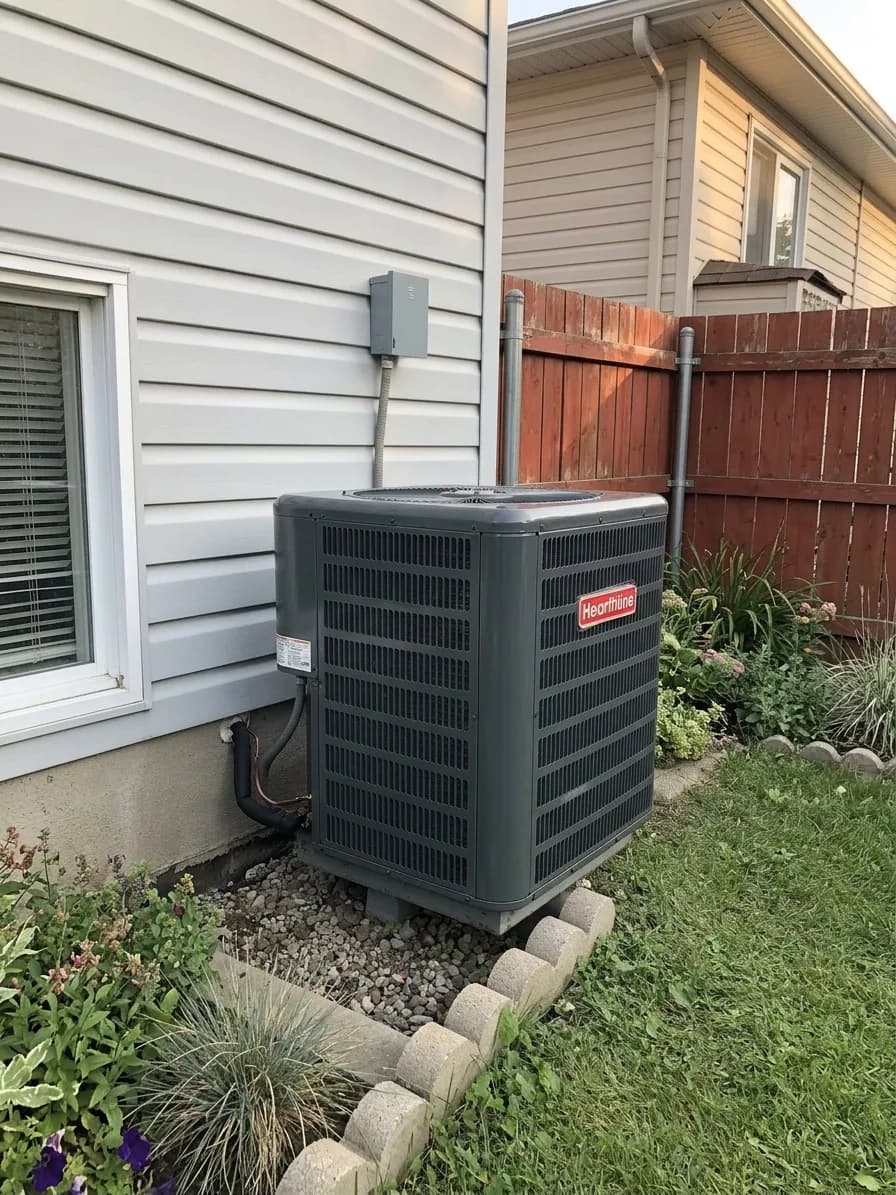
Look at the data plate on the outdoor unit. The model number usually contains a "024" (2 ton), "030" (2.5 ton), "036" (3 ton), "042" (3.5 ton), or "048" (4 ton). The number is the BTU rating in hundreds — "024" = 24,000 BTU = 2 ton.
Ready for a proper sizing assessment?
We run Manual J on every replacement and new install quote, included in the visit, no separate charge. We'll look at your home, run the calculation, walk you through the result, and quote the correctly-sized system. If your existing AC was oversized, we'll show you the math.
Request a quote or read more on AC installation and AC replacement. For homeowners considering whether to upgrade to a heat pump, see our heat pump vs furnace guide for the broader trade-off. Service area: Woodstock + 30-minute radius covering Ingersoll, Tillsonburg, Tavistock, Norwich, Embro, Innerkip, Thamesford, Beachville, Salford, Mount Elgin, Burgessville, and Plattsville.
Common Questions
Frequently asked
How many BTU of AC do I need per square foot?
There's no accurate per-square-foot rule — it depends on insulation, windows, air leakage, and orientation. Rough Oxford County starting ranges: 1 ton (12,000 BTU) for 800-1,200 sq ft, 1.5 ton for 1,200-1,800 sq ft, 2 ton for 1,800-2,400 sq ft, 2.5 ton for 2,400-3,200 sq ft, 3 ton for 3,200-4,000 sq ft. A proper Manual J calculation determines the correct number for your specific home.
What's Manual J and why does it matter?
Manual J is the residential heat-load calculation method published by ACCA — the industry standard for HVAC sizing. It accounts for square footage by room, ceiling height, insulation R-values, window count and orientation, air infiltration, internal gains, and local design temperatures. A proper Manual J takes 30-90 minutes using software like Wrightsoft and produces the specific BTU number for your home. It's the only honest way to size an AC.
Why is an oversized AC bad?
Oversized ACs short-cycle (run 5-10 minutes then shut off), which stresses the compressor, wears electrical components, and burns electricity at start-up rates. They also fail at humidity control — ACs only dehumidify in the second half of a cooling cycle. Oversized ACs leave the house feeling cold and clammy. The temperature is right but the humidity is wrong.
Can I just match the size of my existing AC?
Only if you're sure the existing one was right. Most older ACs in Oxford County were sized by the old square-footage rule of thumb and are oversized for the current home (especially after insulation upgrades or window replacements). Matching the old size perpetuates the problem. Manual J on the current home is the right approach.
How do I know my existing AC is oversized?
Look for short-cycling (running 5-10 minutes then shutting off), uneven room temperatures (some rooms always cold, some always too warm), or a clammy feeling despite the temperature being right. Check the AC's BTU rating against typical numbers for your home size and vintage — a 3-ton AC on a 1,500 sq ft post-2000 home is almost certainly oversized.
What's a ton of cooling?
One ton of cooling equals 12,000 BTU/hour of heat removal. The term comes from the cooling effect of one ton of ice melting over 24 hours. Modern central ACs are sold in half-ton increments: 1 ton, 1.5 ton, 2 ton, 2.5 ton, 3 ton, 3.5 ton, 4 ton. The right size for your home depends on Manual J, not just home size.