Troubleshooting
AC making a loud noise: 7 sounds and what they mean
A loud AC almost always sounds like one of seven things — humming, clicking, buzzing, screeching, banging, grinding, or hissing/gurgling. Each sound points to a different category of repair, from $150 capacitors to $3,000 compressors. Three of seven are safe to keep running while you call.
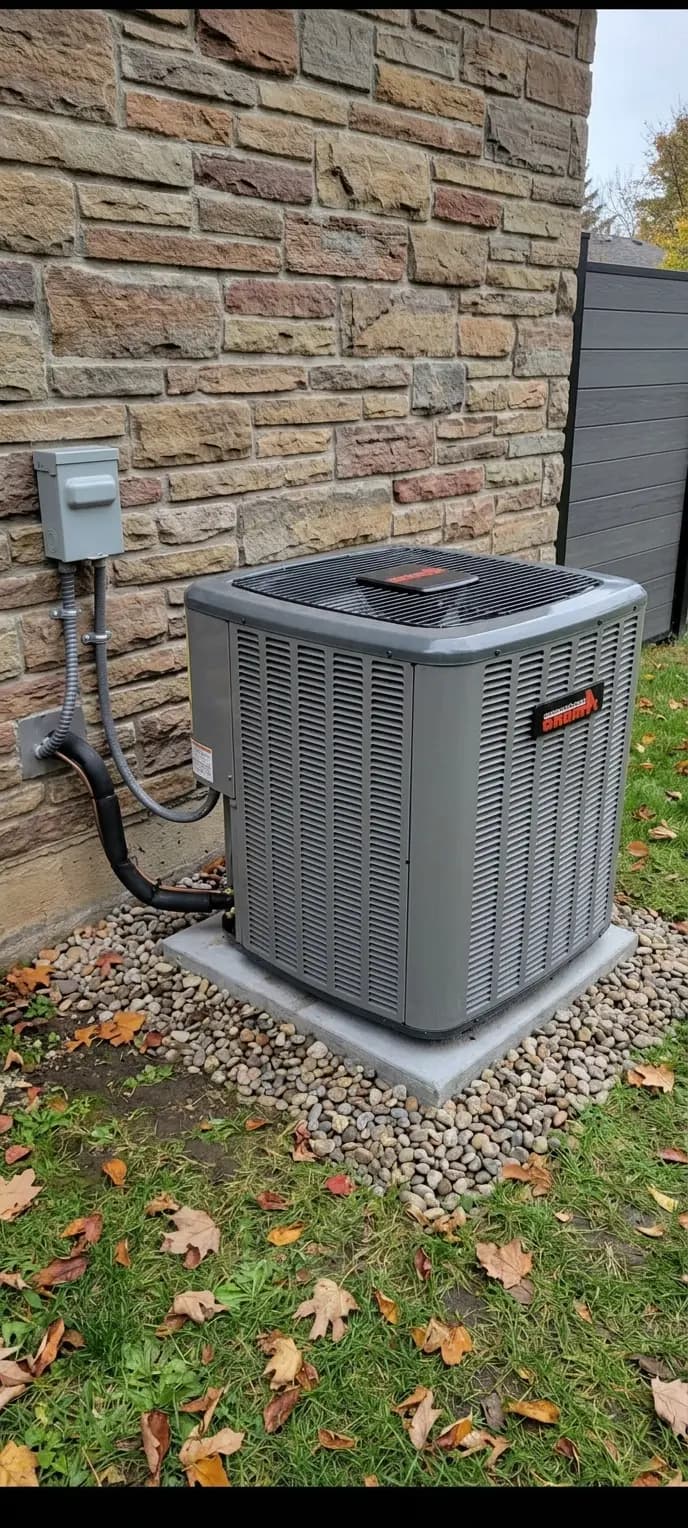
A loud AC almost always sounds like one of seven things — humming (capacitor or contactor), clicking (relay or thermostat), buzzing (electrical or refrigerant flow), screeching (compressor or fan belt), banging (loose part or compressor failure), grinding (motor bearings), or hissing/gurgling (refrigerant or condensate). Each sound points to a different category of repair. Three of the seven are safe to investigate yourself — the rest mean shut the system off and call. This guide walks through what each sound means, how urgent it is, and what the repair usually costs in Oxford County.
If your AC just started making noise it didn't make before, identify which sound from the list below, then decide whether to keep running it or shut it off. Some sounds (humming on startup) are essentially benign. Others (banging from the compressor) can end a $400 capacitor repair becoming a $3,000 compressor replacement if you ignore them. Same-day service when scheduling allows — see our AC repair page for what to expect.
The short version: 7 sounds and what they mean
| Sound | Most likely cause | Urgency |
|---|---|---|
| Humming | Bad capacitor (most common) or stuck contactor | Run if it cools; book within days |
| Clicking | Failing relay or thermostat issue | Run if intermittent; book within a week |
| Buzzing | Electrical fault or refrigerant flow | Shut off if continuous; book immediately |
| Screeching | Compressor pressure or fan belt (rare) | Shut off immediately |
| Banging | Loose part, compressor mount, or compressor failure | Shut off immediately |
| Grinding | Motor bearings failing | Shut off immediately; can damage other parts |
| Hissing or gurgling | Refrigerant leak or condensate | Investigate, then call if leak suspected |
If your AC sounds different from what it sounded like last year and it's in the "shut off immediately" category, run the system on FAN ONLY (heat pumps or AC) until the tech arrives. The blower can keep moving air through the house without involving the noisy compressor or outdoor unit.
1. Humming — the most common noise complaint
A constant low hum from the outdoor unit when the AC starts up but doesn't actually cool is almost always a bad capacitor or a stuck contactor. The compressor is trying to start but can't spin up because the capacitor (which provides the start boost) has failed, or the contactor (which closes the electrical circuit) has welded shut.
What you'll see:
- Thermostat calls for cooling
- Outdoor unit makes a steady humming sound for 30-60 seconds
- Compressor doesn't start
- Either system shuts off automatically (overload trip) or runs warm air through the vents
Why it happens:
- Capacitors fail more often in summer because they work hardest in heat
- Capacitors have a finite lifespan (5-10 years typical); their failure is the single most common AC repair we see
- Contactors fail when their contacts pit and weld together from arcing over time
Urgency: the humming on its own isn't dangerous. The system shuts off automatically if it can't start. But every failed start attempt strains other components — book the repair within a few days, not a few weeks.
Typical repair:
- Capacitor replacement: 30-60 minutes, $150-$280 part and labour combined
- Contactor replacement: 45-90 minutes, $180-$320 part and labour combined
Both are quick fixes once diagnosed. If you hear humming, the diagnosis is usually straightforward.
2. Clicking — relays and thermostats
A clicking sound coming from the outdoor unit or the indoor air handler points to a relay or thermostat issue. Relays click when they switch states; an intermittent click that doesn't lead to the system starting is a relay or contactor problem.
Where the click comes from determines the cause:
- Click from the outdoor unit, no compressor start — failing contactor or relay
- Click from the indoor air handler or furnace area — control board relay or sequencer
- Click from the thermostat itself — thermostat relay (older mechanical-relay thermostats)
- Repeated clicking every few seconds — likely a control issue cycling on and off rapidly
Urgency: intermittent clicking with the system still cooling is something to investigate this week, not today. Continuous clicking with no cooling is more urgent — book a tech.
Typical repair:
- Relay or contactor: $180-$320
- Control board: $350-$650
- Thermostat replacement: $200-$450 (with new thermostat) — see our smart thermostat buying guide
3. Buzzing — usually electrical
Buzzing is the sound to take seriously. It almost always points to an electrical issue — a loose connection arcing, a failing capacitor about to fail, or in rare cases, refrigerant flow through a partially-blocked line.
Distinguishing types of buzz:
- Constant 60Hz buzz from the outdoor unit — electrical issue, often the capacitor on the verge of total failure or a loose wire arcing
- Buzz that varies with refrigerant flow — restricted refrigerant or expansion valve issue (less common)
- Loud buzz that came on suddenly — almost always a failed capacitor that's now leaking dielectric fluid (you may see a swollen or burst capacitor when the cover comes off)
Urgency: shut off the system and call. Buzzing electrical faults can become fires if ignored. The breaker should trip first in most cases, but don't rely on it.
Typical repair:
- Capacitor replacement: $150-$280
- Loose wiring repair: $130-$220 service visit
- Refrigerant flow diagnosis: $250-$500 depending on scope
4. Screeching — compressor or belt
A high-pitched screech from the outdoor unit is almost always a compressor under high pressure — meaning the system is operating outside safe parameters and something is preventing normal refrigerant flow. Less commonly, a screech can come from a fan belt (only on very old AC systems with belt-driven fans; modern direct-drive fans don't have belts).
What it points to:
- Excessive pressure in the refrigerant circuit (overcharged refrigerant, blocked condenser coil, failing compressor valve)
- Failing compressor internal bearings (occasionally)
- Old belt-driven fan motor (rare on modern equipment)
Urgency: shut off the system. Compressor screeches indicate operation outside spec. Continuing to run can destroy the compressor — and compressor replacement is the most expensive single repair on a residential AC, easily $1,800-$3,500.
Typical repair:
- Refrigerant adjustment: $220-$400
- Condenser coil cleaning (heavy duty): $250-$450
- Compressor replacement: $1,800-$3,500 (often pushes the system into replace-the-whole-AC territory — see our AC repair vs replace guide)
5. Banging — loose parts or compressor failure
A loud banging or clanking that starts when the compressor kicks on is one of the most concerning AC sounds. It usually means a part is loose inside the compressor or somewhere in the outdoor unit, and the part is being struck repeatedly by moving components.
Common causes:
- Compressor mount springs broken (the compressor was suspended in springs to dampen vibration; one or more springs failed and the compressor is now banging against the housing)
- Loose hardware inside the compressor case (rare but serious)
- Failing compressor internals (bearings, piston, rod)
- Refrigerant slug from oil migration (uncommon but happens after refrigerant charge issues)
Urgency: shut off the system immediately. Every additional bang is one more impact on a worn part. Banging compressors that are caught early can sometimes be saved (replace mount springs, isolate the loose hardware). Compressors that get run for weeks with banging often need full replacement.
Typical repair:
- Mount spring replacement and rebuild: $400-$800
- Loose hardware repair: $200-$450
- Compressor replacement: $1,800-$3,500
6. Grinding — bearings failing
A continuous grinding sound from the outdoor unit's fan or the indoor air handler's blower motor points to failing bearings. The fan or blower motor has bearings (the parts the shaft rotates on); when they wear out, you hear metal-on-metal grinding.
Where it's grinding from matters:
- Outdoor fan motor grinding — outdoor condenser fan motor bearings failing
- Indoor blower grinding — indoor air handler / furnace blower motor bearings failing (same blower used for AC and heating)
Urgency: shut off the system. Bearings that grind for long enough lock up entirely. When they lock, the motor draws excessive current, the breaker should trip, but if it doesn't the motor can melt — and a melted motor can take other components (capacitor, contactor) with it.
Typical repair:
- Outdoor fan motor replacement: $400-$700
- Indoor blower motor replacement: $500-$900
A grinding sound caught early is a motor replacement. Ignored, it becomes a motor + capacitor + contactor + control board cascade that easily doubles the repair cost.
7. Hissing or gurgling — refrigerant or condensate
Hissing or gurgling sounds are usually refrigerant or water related — not electrical.
Hissing:
- High-pitched hiss from copper lines or the indoor coil — refrigerant leak (small leaks make a faint hiss as gas escapes through a pinhole)
- Hiss from the expansion valve area — normal sound as refrigerant flashes from liquid to gas during the cooling cycle (no action needed if it's always been there)
Gurgling:
- Gurgling from the refrigerant lines — air or moisture trapped in the refrigerant circuit (system needs service to evacuate and recharge)
- Gurgling from the condensate drain pan — water flow through the drain (normal if AC is running and producing water; abnormal if the pan is overflowing — see our condensate pump troubleshooting guide)
Urgency: if you suspect a refrigerant leak (sustained hiss, system cooling less than usual, ice on the lines), get it diagnosed soon. Refrigerant leaks become bigger as the pinhole grows. R-22 systems are urgent because top-ups are expensive and increasingly rare; R-410A systems are less urgent on cost but still need the leak found.
Typical repair:
- Leak detection and repair: $400-$900
- Refrigerant recharge (R-410A): $250-$600
- Refrigerant recharge (R-22, when available): $500-$1,200
- Condensate drain or pump fix: $150-$350
For older R-22 systems with refrigerant leaks, the math often favours full replacement over repair — see our AC repair vs replace guide.
What to do right now
If your AC is making noise, follow this flow:
- Identify which of the 7 sounds matches your situation — listen carefully, walk around to localize the source (outdoor unit vs indoor air handler)
- Check the urgency table at the top of this guide
- If "shut off immediately" — turn the thermostat to OFF, run FAN ONLY for circulation, call
- If "book within days" — keep running, but book the service
- Note when the sound started, what time of day it's loudest, whether the system is still cooling
A quick video recording of the sound (phone microphone next to the outdoor unit) helps the tech narrow down the diagnosis before arriving. Two minutes of video is worth more than a paragraph of description.
What to have ready when you call
A few details speed up the diagnostic:
- Which of the 7 sounds matches (or "I can't tell, here's a recording")
- Where the sound is coming from (outdoor unit vs indoor air handler)
- When it started
- Whether the system is still cooling normally
- Age of the AC (rough is fine — "around 10 years")
- Whether you've had any recent service or refrigerant top-up
- Make and brand (printed on the outdoor unit nameplate)
How urgent is "shut off immediately"?
Some homeowners feel awkward shutting the AC off on a 30°C day. The straightforward way to think about it: most AC failures cost $200-$500 to repair if caught early. The same failures, run for days, cascade into $1,500-$3,500 repairs because the original failed part takes other components with it.
If your AC is banging, grinding, screeching, or buzzing electrically — the $200 capacitor / $400 motor repair is cheap. The $2,000 compressor repair that happens because you kept running it for a week is not. Running FAN ONLY mode (which doesn't engage the compressor) gives you air circulation without continuing the damage.
Common questions
Why is my AC suddenly noisier this summer than last summer?
Capacitors degrade over time. A capacitor at 80% capacity hums slightly during startup; the same capacitor at 30% capacity hums loudly. The progression is often slow enough that you don't notice until it's significantly worse. A spring tune-up catches this (see our spring AC tune-up guide) by measuring capacitor capacity before it becomes audible.
Is normal AC noise loud?
A properly-operating outdoor AC unit produces a steady moderate noise — running compressor + spinning fan = about 50-65 decibels measured at 3 feet (similar to a conversational voice). Any sound louder than your AC has historically been, or any new sound that wasn't there before, is worth investigating.
Can I clean my outdoor unit myself to make it quieter?
Yes, gentle cleaning is fine. Rinse the outdoor coil from inside out with a garden hose at low pressure. Don't use a pressure washer — fins are soft aluminum and bend easily. A heavily clogged outdoor coil makes the compressor work harder and run hotter, which can amplify noises. This is one of the few maintenance items homeowners can do safely.
Why does my AC make a clicking sound at startup and shutdown?
That's normal. The contactor relay clicks when closing (startup) and opening (shutdown). The sound is loudest right next to the outdoor unit. If the click is followed by the compressor running normally, it's fine. If it's followed by humming without compressor start, that&apos>s the bad capacitor scenario in section 1.
How long does an AC last before getting noisy?
Most modern ACs run quietly for the first 8-10 years. Years 10-15 typically see increased noise as capacitors degrade, fan motors age, and contactor contacts pit. Years 15+ are often where major component failures (compressor, control board) start happening. For the broader lifespan / replacement discussion, see our AC repair vs replace and $5,000 rule guides.
My AC is loud at night but quiet during the day. Why?
Almost always because nighttime ambient noise is lower, so the same AC sound seems louder by contrast. If the actual AC sound hasn't changed, this is normal. If the AC really is louder at night (load conditions, longer run cycles in deep cold or deep heat), the diagnosis is the same as for any noise — match to the 7 categories above.
Is there anything I can do to make my AC quieter overall?
A few options:
- Replace an old single-stage AC with a modern two-stage or variable-speed unit (significantly quieter at the same cooling capacity)
- Plant a hedge or install a sound-dampening fence around the outdoor unit (drops perceived noise 5-10 dB)
- Install vibration-isolating pads under the outdoor unit (reduces transmission to the house)
- Keep the outdoor unit clean and serviced annually
Most "quieter AC" conversations are really about replacing very old single-stage equipment with modern variable-speed. For most Oxford County homes that aren't already running variable-speed, a quiet upgrade is one of the better comfort improvements available.
Still loud or worried about a sound?
Request a service call and mention the type of sound in the message — we'll prioritize urgent ones. Same-day service when scheduling allows. Service area: Woodstock + 30-minute radius covering Ingersoll, Tillsonburg, Tavistock, Norwich, Embro, Innerkip, Thamesford, Beachville, Salford, Mount Elgin, Burgessville, and Plattsville. See AC repair details for what to expect at the visit, or our broader AC not cooling troubleshooting guide if your system is also failing to keep up.
Common Questions
Frequently asked
Why is my AC suddenly loud?
Seven common sounds with different causes: humming (bad capacitor or stuck contactor — most common), clicking (failing relay or thermostat), buzzing (electrical fault — urgent), screeching (compressor under high pressure — shut off), banging (loose part or compressor failure — shut off), grinding (motor bearings failing — shut off), hissing or gurgling (refrigerant leak or condensate).
Why is my AC humming but not cooling?
Almost always a bad capacitor. The compressor is trying to start but can't spin up because the capacitor (which provides the start boost) has failed. The motor hums for 30-60 seconds then shuts off on overload protection. Capacitor replacement takes a tech 30-60 minutes and runs $150-$280 in parts and labour. Most common AC repair.
Is it safe to run an AC making weird noises?
Depends on the noise. Humming or occasional clicking — usually safe for a few days while you book service. Buzzing, screeching, banging, or grinding — shut the system off immediately. The $200 capacitor repair becomes a $2,000 compressor replacement when you run a damaged system for a week.
Why is my AC making a banging noise?
Most often broken compressor mount springs (the compressor was suspended in springs to dampen vibration; one failed), loose hardware inside the compressor case, or failing compressor internals. Banging compressors caught early can sometimes be repaired ($400-$800). Banging compressors run for weeks usually need full replacement ($1,800-$3,500).
What does it mean if my AC is hissing?
A high-pitched hiss from the copper lines or indoor coil is usually a refrigerant leak — a small pinhole letting gas escape. Get it diagnosed soon. Refrigerant leaks grow over time. R-22 systems are more urgent because top-ups are expensive and increasingly rare; R-410A systems are less cost-urgent but still need the leak found.
Should I worry about a clicking sound from my outdoor AC unit?
A single click at startup and shutdown is normal — that's the contactor relay closing and opening. Repeated clicking with no compressor start, or constant clicking every few seconds, points to a failing contactor, relay, or thermostat issue. Book service this week.