Maintenance
Dry winter air in your house: causes, fixes, and when to add a humidifier
Dry winter air in Oxford County is physics — cold outside air holds no moisture, and heating it drops the indoor RH below 25%. The fix is portable humidifier, whole-home bypass, steam humidifier, or sometimes the opposite: less ventilation in deep cold. Here's how to pick.
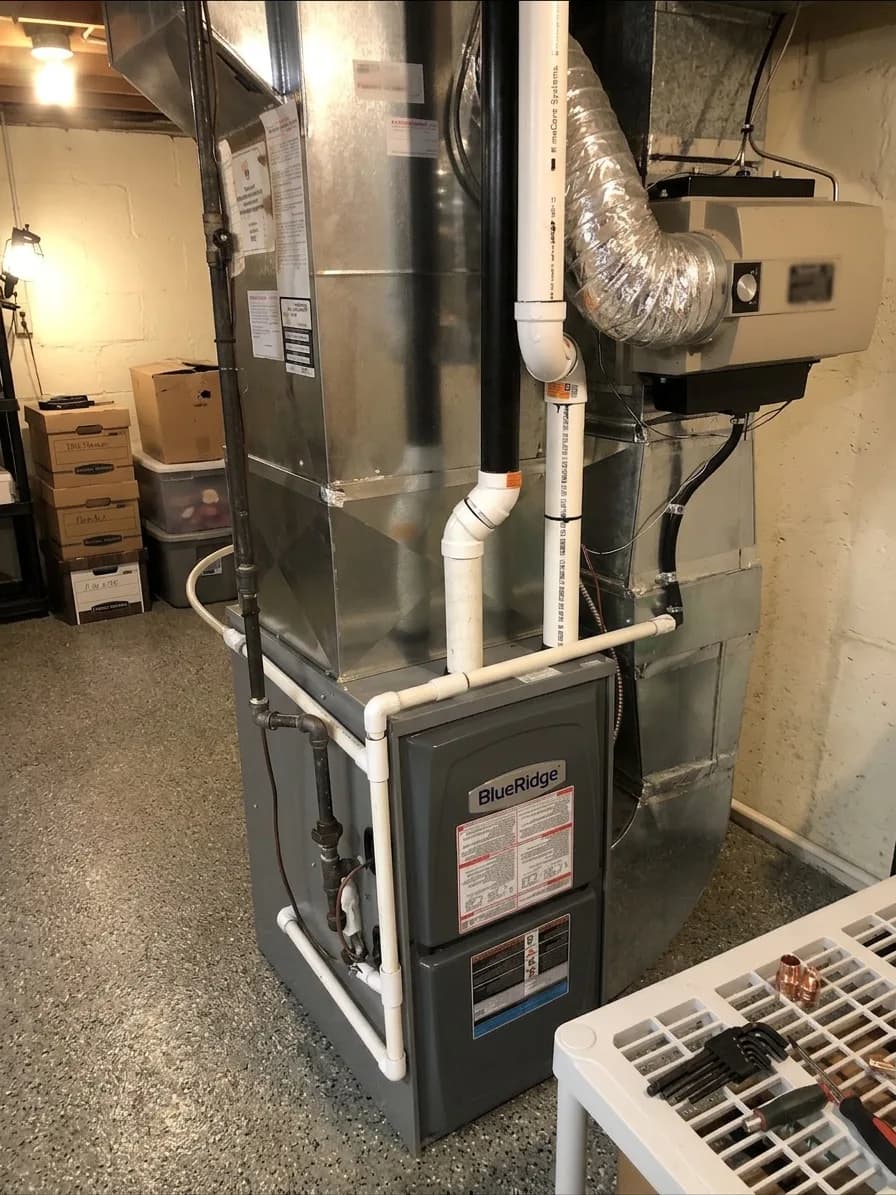
Dry winter air in Oxford County homes is a function of physics — cold outside air holds very little moisture, and when it's heated to room temperature, the relative humidity drops below 20-25%. The ideal indoor range is 35-45%. Below that you get static shocks, cracked floors, dry skin, sinus issues, and your wood furniture starts splitting. The fix is either a portable humidifier in the worst rooms, a whole-home humidifier integrated into the furnace, or — if the home is very tight and over-humidifying — running the HRV more aggressively. This guide walks through which fix matches which home, the trade-offs between bypass and steam humidifiers, and the gotchas that catch homeowners out.
If your house has felt unusually dry this winter (static when you touch a doorknob, cracking lips, hardwood floor gaps wider than usual), this guide will help you figure out whether it's normal Ontario winter dryness, a humidifier failure, or a deeper ventilation issue.
The short version
| Symptom | Likely indoor RH | Recommended action |
|---|---|---|
| Static shocks, cracking floors, dry skin | Under 25% | Add or service a humidifier |
| Comfortable, no symptoms | 35-45% (ideal) | No action |
| Window condensation, mould smell | Over 55% | Reduce humidification or add ventilation |
| Sustained 50%+ in deep cold | Over 50% | Stop humidifying — too much |
Knowing the actual humidity level matters more than guessing. A $15 hygrometer (or a smart thermostat that reads RH — see our smart thermostat buying guide) tells you what you're actually dealing with.
Why Ontario winters dry out indoor air
Cold air physically cannot hold much water vapour. When -10°C outside air at 80% relative humidity is brought into the house and heated to 21°C, the moisture content stays the same but the relative humidity (the air's capacity at that warmer temperature) drops to roughly 12%. That's desert-dry — most Sahara measurements run 15-25%.
The colder the outside air, the drier your inside air becomes by default. A few rough Ontario winter numbers:
| Outside temp | Outside RH at 80% | Indoor RH at 21°C (heated) |
|---|---|---|
| -5°C | 80% | ~22% |
| -10°C | 80% | ~12% |
| -15°C | 80% | ~9% |
| -20°C | 80% | ~6% |
| -25°C | 80% | ~4% |
Every cubic foot of outside air that enters the house (through windows, doors, leaks, mechanical ventilation) drops the indoor RH. The leakier the house, the worse it gets. Older 1970s homes leak meaningfully more than modern post-2010 builds and tend to dry out faster.
What 25% RH actually feels like
The symptoms of low indoor RH show up in fairly predictable order:
- Below 30%: static shocks when touching metal, slightly dry skin, occasional itchy eyes
- Below 25%: noticeable dry lips, sinus irritation, sleep disrupted by dry throat, harder to breathe deeply
- Below 20%: persistent congestion, nosebleeds in sensitive people, visibly drying houseplants
- Below 15%: hardwood floors gap and squeak, wood furniture cracks at joints, books and papers curl, electronics show ESD issues
The ideal range for human comfort and material preservation is 35-45%. Below 30% your body notices; below 25% your home starts noticing.
The four fixes for dry winter air
There are four broad approaches to addressing dry winter air. Each fits a different situation.
Option 1: Portable / room humidifier. A 1-3 gallon unit running in the bedroom or main living area. Adds moisture to one or two rooms. Costs $30-$250 depending on capacity and features. Maintenance: refill daily or every few days, clean weekly to prevent mineral buildup and bacteria.
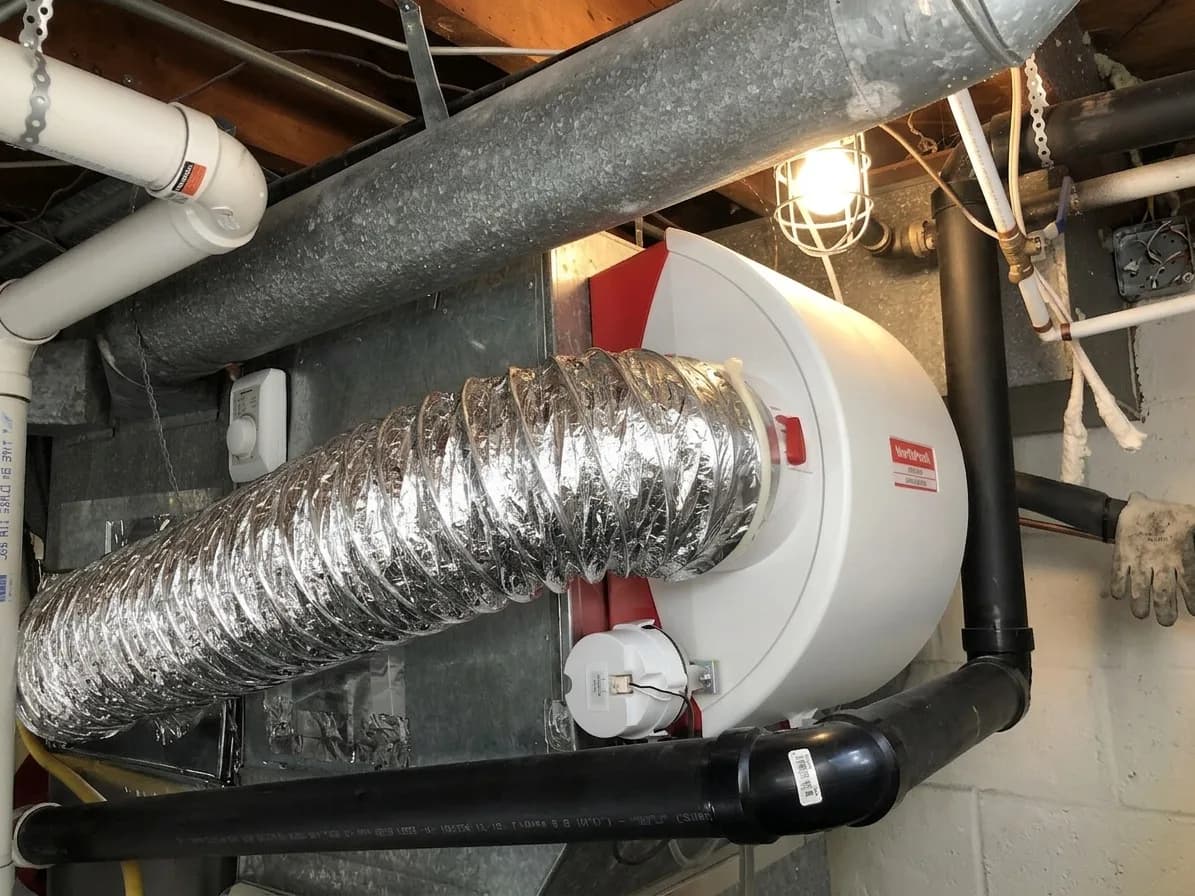
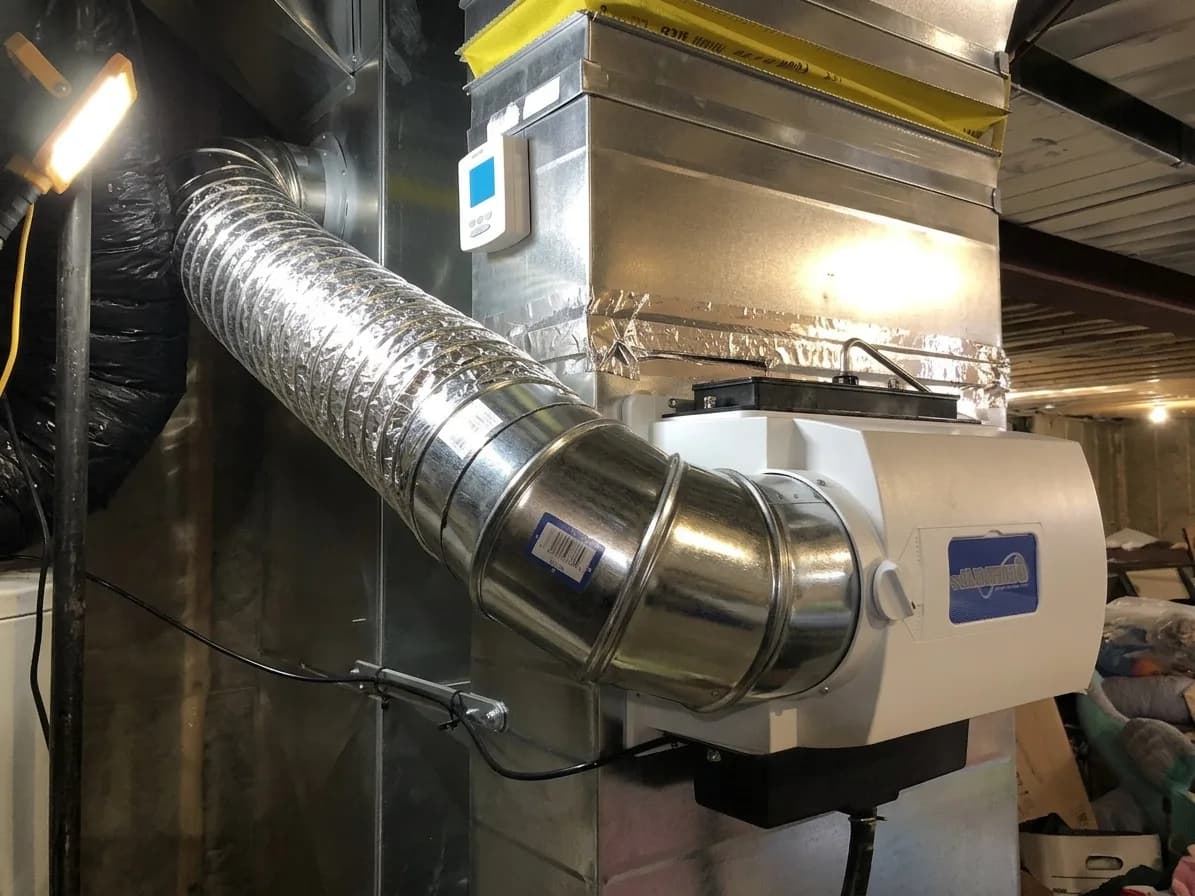
Option 2: Whole-home bypass humidifier. A unit installed on the furnace return duct that adds moisture to the air being circulated by the furnace. Connects to a water supply line and drains to a floor drain. Maintenance: replace pad annually, occasional cleaning of mineral buildup. Cost installed: $400-$900.
Option 3: Whole-home steam humidifier. A more sophisticated unit that boils water to produce steam injected into the duct. Better humidity output and easier to control precisely than bypass. Cost installed: $1,200-$2,500. Used in larger homes, very dry climates, or homes with specific humidity demands (humidor rooms, music studios, art collections).
Option 4: Don't humidify — fix the ventilation instead. Sometimes the right answer in tight modern homes is to run less ventilation in deep cold (lower HRV speed) or seal more air leaks rather than fight the dry air with humidification. If the house is leaky enough that you can't humidify it to 35% without massive water consumption, the actual fix is air sealing, not adding more water.
Bypass vs steam humidifier — the comparison
For homes installing a whole-home humidifier, the choice between bypass and steam is the main decision.
| Feature | Bypass humidifier | Steam humidifier |
|---|---|---|
| How it works | Air diverted through a wet pad evaporates moisture | Heats water to steam, injects into duct |
| Typical install cost | $400-$900 | $1,200-$2,500 |
| Output | Limited by furnace runtime + airflow | Steady output regardless of furnace |
| Furnace dependency | Only humidifies when furnace is running | Can run independently of furnace |
| Water consumption | Moderate | Higher (boiling water) |
| Energy use | Minimal (just water and bypass) | Significant electricity (heater elements) |
| Best for | Most Oxford County homes | Large homes, very dry climates, specific RH needs |
| Maintenance | Annual pad replacement, occasional cleaning | Annual canister or scale cleaning, more involved |
For most Oxford County homes, a bypass humidifier is the right answer — install cost is reasonable, it humidifies the whole house, and the furnace runs enough in winter that the bypass-while-furnace-runs pattern works.
Steam humidifiers make sense in homes over 3,000 sq ft, homes with tight 2020+ construction (less furnace runtime), or homes where the homeowner wants precise RH control independent of the furnace.
Smart-controlled humidifiers — the modern way
Older humidifiers used a basic humidistat: dial the dial to set the target RH, the humidifier ran whenever indoor RH was below target. Modern humidifiers integrate with smart thermostats (Ecobee, Honeywell T9, some Nest applications) to:
- Adjust target RH based on outside temperature — humidify to 40% when it's -5°C outside, drop the target to 25% when it's -25°C to prevent window condensation
- Monitor for window condensation risk — some thermostats use dew-point math to back off RH automatically
- Report on water consumption and operation — useful for catching humidifier failures (stuck open / stuck closed)
The Ecobee Premium and Honeywell T9 do this best — see the smart thermostat buying guide for the broader thermostat comparison.
Window condensation — the symptom of too much humidity
Excessive humidification creates condensation on cold surfaces — primarily windows. Mid-winter condensation on the inside of double-pane windows in the corners of the home is a sign the indoor RH is too high for the window temperature.
Outdoor-temperature-driven RH targets (rough guide):
| Outside temp | Maximum indoor RH (no condensation risk on most windows) |
|---|---|
| 0°C | 45% |
| -10°C | 40% |
| -15°C | 35% |
| -20°C | 30% |
| -25°C | 25% |
| -30°C | 20% |
If you're seeing condensation, drop the humidifier target. If the condensation persists at lower humidity, the windows themselves are colder than the room air (single-pane, leaky, or aluminum frames) and even modest humidity will condense. Window upgrades fix the root cause; humidifier adjustments are a temporary fix.
Integration with HRVs and ERVs
If your home has a Heat Recovery Ventilator (HRV) or Energy Recovery Ventilator (ERV), the humidification conversation is different. An HRV brings in cold outside air, which lowers indoor RH every time it runs. An ERV exchanges some moisture between airstreams, which partially recovers humidity.
HRV + dry-air situation: the HRV is amplifying the dry winter air problem. Solutions: run the HRV less aggressively in deep cold (lower fan speed or shorter cycles), add a whole-home humidifier sized for the air change rate, or move to an ERV if humidity recovery would help.
ERV + dry-air situation: less common but happens. ERVs aren't magical — they recover some moisture but not all. In very cold dry winters even ERV-equipped homes can dry out below comfortable levels. Treat as you would an HRV setup.
See our HRV vs ERV for Ontario homes guide for the broader ventilation conversation.
Should you humidify a leaky old house?
Older 1970s and earlier homes have a real choice point. The house leaks enough that mechanical humidification is fighting the natural air exchange. You can:
- Humidify aggressively — install a steam humidifier and run the water bill up. Some homeowners do this; it works.
- Live with low RH — accept that the house is going to be dry, run a portable in the bedroom for sleep comfort, leave it at that. Many homeowners do this; it's reasonable.
- Tighten the house first, humidify second — air sealing, weatherstripping, window upgrades — then humidification works much better and uses less water.
The third option is the long-term fix. Air sealing pays back in heating cost too, so the economics are usually reasonable.
Common mistakes
A few patterns that come up regularly:
Setting the humidistat at 45% in deep cold. Causes window condensation, mould growth in windowsills, and over time can damage window frames. Drop the target during cold snaps.
Running a portable humidifier all winter without cleaning it. The water reservoir grows bacteria and minerals. You're aerosolizing whatever's in there into your breathing air. Clean weekly, descale monthly. Replace water daily.
Installing a humidifier without sealing the duct connections. Air leaks at the install create unconditioned air mixing. Defeats the humidifier's output.
Ignoring the humidifier's water supply line. Most bypass humidifiers connect to a 1/4-inch saddle valve on a copper water line. These can leak slowly. Inspect annually.
Forgetting to switch the humidifier off in summer. Most bypass humidifiers have a manual switch on the side. If left running in summer with AC, the humidifier adds moisture exactly when you're trying to remove it. Costs you money on the cooling bill and stresses the AC.
How we approach humidifier installs
When we install a humidifier as part of a furnace project or as a standalone retrofit:
- Assess the home — square footage, vintage, current ventilation (HRV/ERV?), windows, household sensitivity
- Test current indoor RH — sometimes the home isn't actually dry, it just feels that way
- Pick the right type — bypass for most, steam for niche cases
- Locate the install point — return duct, with access to a water supply and a drain
- Integrate with the thermostat if available — smart-control wins almost every time
- Walk through annual maintenance — homeowner pad replacement vs annual tune-up
Typical bypass humidifier install runs $400-$900 depending on plumbing complexity and whether the existing return duct geometry needs modification. Steam humidifier install $1,200-$2,500 depending on equipment selection.
Common questions
What humidity level should I keep my home at in winter?
Aim for 35-45% in mild winter weather (above -10°C outside). Drop the target as it gets colder to prevent window condensation: roughly 35% at -15°C, 30% at -20°C, 25% at -25°C. Below 25% is "uncomfortable but won't cause damage." Below 15% starts damaging wood floors and furniture.
Is a humidifier worth it for a small house?
For a 1,000-1,500 sq ft home, a single portable humidifier in the main living space gives good results and costs $60-$200. A whole-home bypass humidifier ($400-$900 installed) is overkill unless you specifically want the whole house humidified.
Why is my house drier than my neighbour's?
Three common reasons: more outdoor air infiltration (leakier construction), more mechanical ventilation running (HRV at higher speed), or the neighbour has a humidifier you don't. Modern tight construction also dries less because less outside air comes in.
Are humidifiers bad for furniture / hardwood floors?
Properly-controlled humidity (35-45%) protects wood furniture and floors. Too dry (under 25%) causes cracking and gapping. Too humid (over 55% sustained) causes warping. The Goldilocks zone is wider than most people think — anywhere in 30-50% is fine for wood.
Can a humidifier help with COVID, colds, or flu?
Mid-range humidity (40-60%) reduces transmission of some respiratory viruses by causing droplets to fall out of air faster, and reduces dryness-related throat irritation that can mask symptoms. It's not a substitute for ventilation, filtration, or vaccination. Run alongside a MERV 11-13 filter (see MERV filter ratings explained) and an HRV for the strongest indoor-air-quality stack.
Why does the indoor humidity drop when I open windows?
Cold outside air has very little moisture. Opening a window lets cold dry air in and warm humid air out. Five minutes of open window in -15°C weather can drop indoor RH by 5-10 percentage points. The recovery takes hours.
Are evaporative humidifiers safer than ultrasonic ones?
Slightly. Evaporative humidifiers (wick or pad) produce water vapour by evaporation, which leaves minerals and impurities behind in the reservoir. Ultrasonic humidifiers atomize water, including minerals, into the air — so you can see white dust around the room. Both are safe with clean water and regular cleaning. Whole-home humidifiers integrated into the furnace are evaporative and don't create white dust.
Ready to address dry winter air?
We can assess your current ventilation setup, install a bypass or steam humidifier, integrate it with a smart thermostat, and walk through annual maintenance. We'll also flag if the actual fix is air sealing or HRV adjustment rather than adding more water.
Request a quote or read more on our humidifier and dehumidifier service, HRV vs ERV comparison, and our ventilation services hub. Service area: Woodstock + 30-minute radius covering Ingersoll, Tillsonburg, Tavistock, Norwich, Embro, Innerkip, Thamesford, Beachville, Salford, Mount Elgin, Burgessville, and Plattsville. Same-day service when scheduling allows.
Common Questions
Frequently asked
What humidity level should I keep my Ontario home at in winter?
Aim for 35-45% in mild winter weather (above -10°C). Drop the target as it gets colder to prevent window condensation: roughly 35% at -15°C, 30% at -20°C, 25% at -25°C. Below 25% is uncomfortable but won't damage the house. Below 15% starts cracking wood floors and furniture.
Do I need a whole-home humidifier or just a portable one?
For 1,000-1,500 sq ft homes, a single portable in the bedroom or main living space works well ($60-$200). For 1,500+ sq ft homes or homes wanting consistent humidity throughout, a whole-home bypass humidifier on the furnace ($400-$900 installed) is the right call. Steam humidifiers ($1,200-$2,500 installed) make sense for larger homes or specific RH needs.
What's the difference between a bypass and a steam humidifier?
Bypass humidifiers divert air through a wet pad on the furnace return duct, evaporating moisture into the airstream. Only run when the furnace is running. Cheapest install. Steam humidifiers heat water to steam and inject it into the duct — independent of furnace runtime, more output, more precise control. Bypass works for most homes; steam fits larger or tighter homes.
Why is there condensation on my windows in winter?
Indoor humidity is higher than what the window glass temperature can sustain. The fix is either lowering the indoor RH (turn down the humidifier in deep cold) or warming the window (better windows, insulating cellular shades). Sustained condensation can damage window frames and grow mould — worth addressing.
Can my HRV cause dry winter air?
Yes — Heat Recovery Ventilators bring in cold outside air which lowers indoor RH every time they run. The fix is either running the HRV less aggressively in deep cold (lower fan speed or shorter cycles), adding a whole-home humidifier sized for the air change rate, or considering an ERV (which recovers some moisture between airstreams).
Does dry air affect viruses or colds?
Yes — mid-range humidity (40-60%) reduces transmission of some respiratory viruses and reduces throat dryness that can mask symptoms. It's not a substitute for ventilation, filtration, or vaccination. Running a humidifier alongside a MERV 11-13 filter and an HRV is the strongest indoor-air-quality stack.